

The Rise of Global Hotel Expansion in Morocco: 7 Powerful Opportunities Driving Exceptional Growth
The global hotel expansion in Morocco is no longer a cyclical tourism phenomenon, it represents a deep structural reconfiguration of the country’s economic positioning within the global hospitality industry. What is unfolding is not simply the addition of hotel rooms, but the emergence of a new investment architecture where international capital, operational expertise, and real estate strategies converge to redefine value creation.
Morocco is transitioning from a destination-driven tourism market to an integrated hospitality economy. In this new paradigm, hotels are not standalone assets but strategic nodes within a broader ecosystem that includes infrastructure, mobility, digital distribution, and experiential tourism.
At the center of this transformation lies the global hotel expansion in Morocco, driven by a unique combination of macroeconomic stability, aggressive tourism strategy, and increasing global investor confidence.
Global Hotel Expansion in Morocco and the New Investment Cycle
The current wave of the global hotel expansion in Morocco signals the beginning of a new investment cycle fundamentally different from previous phases. Historically, hotel development in the country was primarily led by domestic investors operating within fragmented structures. Today, the landscape is dominated by institutional capital and multinational hospitality operators deploying scalable and standardized models.
Three structural drivers explain this acceleration:
- Exceptional tourism growth across multiple segments
- Strong penetration of international hotel brands
- Strategic anticipation linked to global events, particularly 2030
These forces are not independent. Together, they form a synchronized investment narrative that positions Morocco as a high-yield, medium-risk hospitality market within emerging economies.
This shift introduces a more sophisticated investment logic, where asset ownership, brand management, and operational execution are increasingly separated, creating both efficiency gains and new economic tensions.
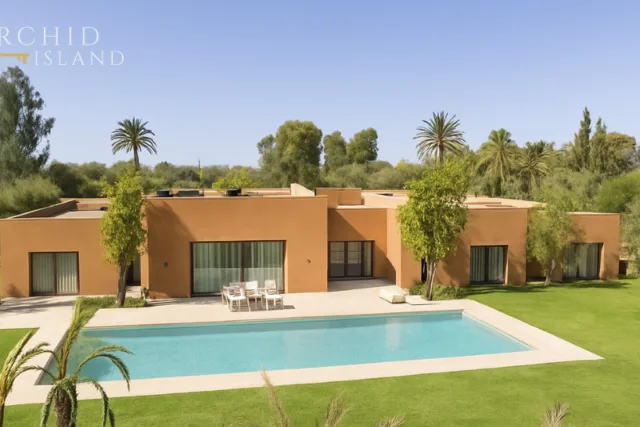
Real Estate Investment Holy Grail in Marrakech.
Tourism Growth as the Foundation of Expansion
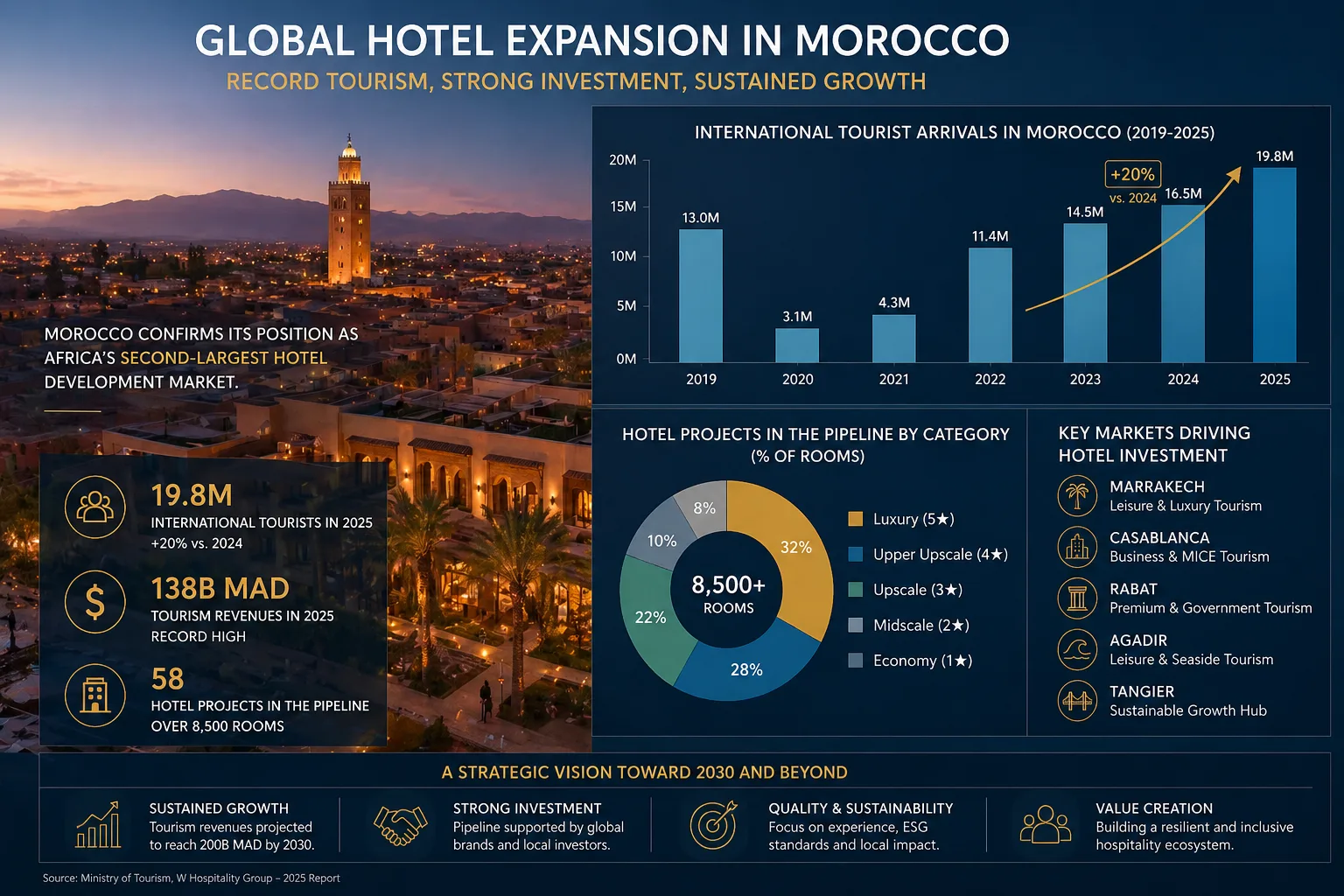
At the core of the global hotel expansion in Morocco lies a sustained increase in tourism performance that goes beyond short-term recovery trends. The country has entered a phase of structural demand growth supported by long-term policy decisions and infrastructure investments.
Air connectivity has expanded significantly, linking Moroccan cities to major global hubs. At the same time, national branding strategies have repositioned the country from a traditional cultural destination to a multi-dimensional tourism platform.
Key urban centers such as Marrakech, Casablanca, and Agadir now operate as integrated nodes within global travel networks. These cities attract a diversified demand base, including:
- Leisure tourism
- Business travel
- High-net-worth individuals
- Long-stay remote workers
This diversification is critical. It reduces exposure to seasonality while increasing revenue stability, two essential factors supporting the scalability of the global hotel expansion in Morocco.
The Dominance of International Hospitality Operators
A defining characteristic of the global hotel expansion in Morocco is the rapid consolidation of market influence by international hotel groups. Unlike earlier entry phases, global brands are no longer experimenting with the market, they are deploying aggressive expansion strategies.
The dominant model relies on management contracts and franchise agreements. This approach allows operators to scale quickly without committing significant capital to physical assets.
The structure typically follows a clear division:
- Local investors finance land acquisition and construction
- International brands control operations, pricing, and distribution
This model, often referred to as “asset-light,” has become the backbone of the global hotel expansion in Morocco.
While it increases operational efficiency and ensures global standards, it also introduces a structural imbalance in value capture. Local capital assumes financial risk, while international operators secure recurring revenue streams through management fees and brand premiums.
Urban Reconfiguration and Hospitality Zoning
The global hotel expansion in Morocco is not only reshaping the hospitality sector, it is redefining urban geography. Cities are increasingly being repositioned according to specialized hospitality functions aligned with global demand patterns.
Marrakech: Luxury and Experiential Tourism
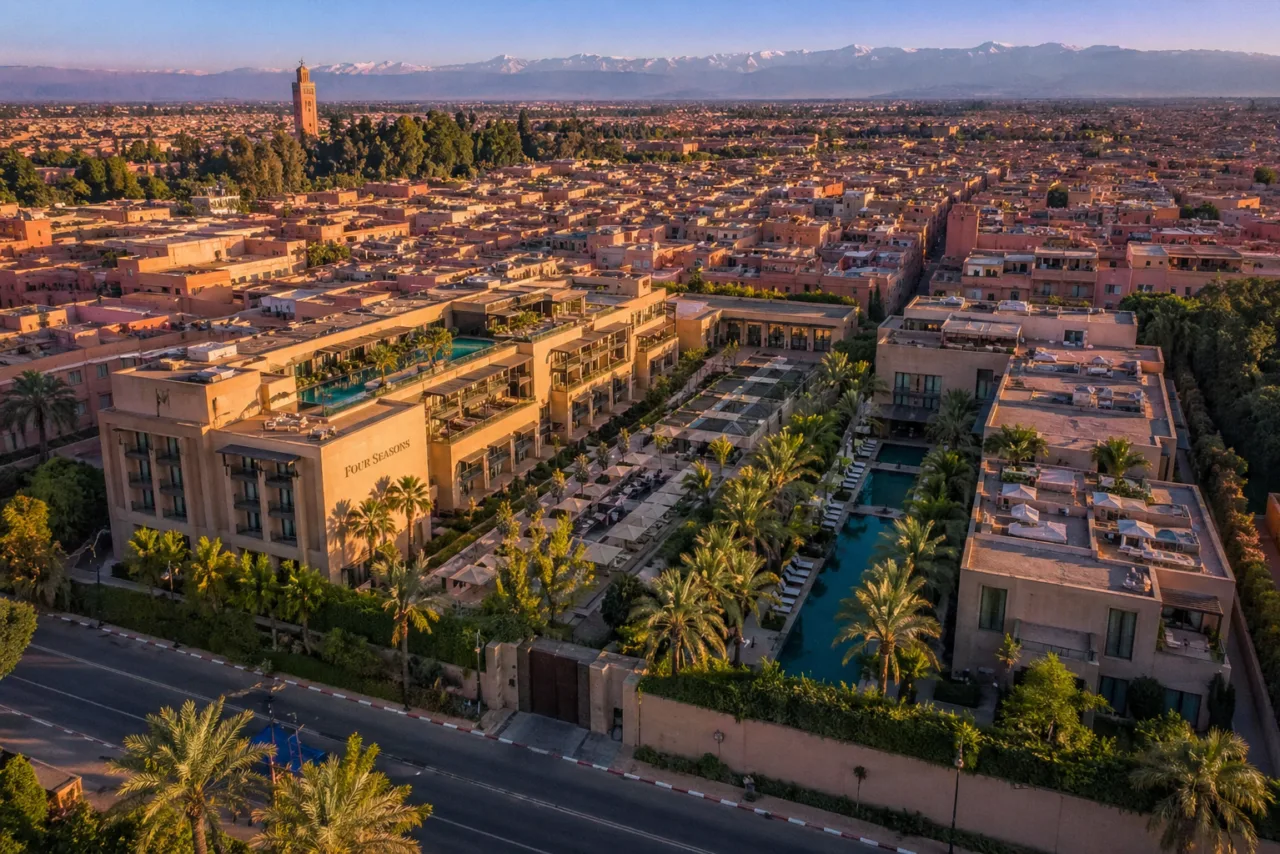
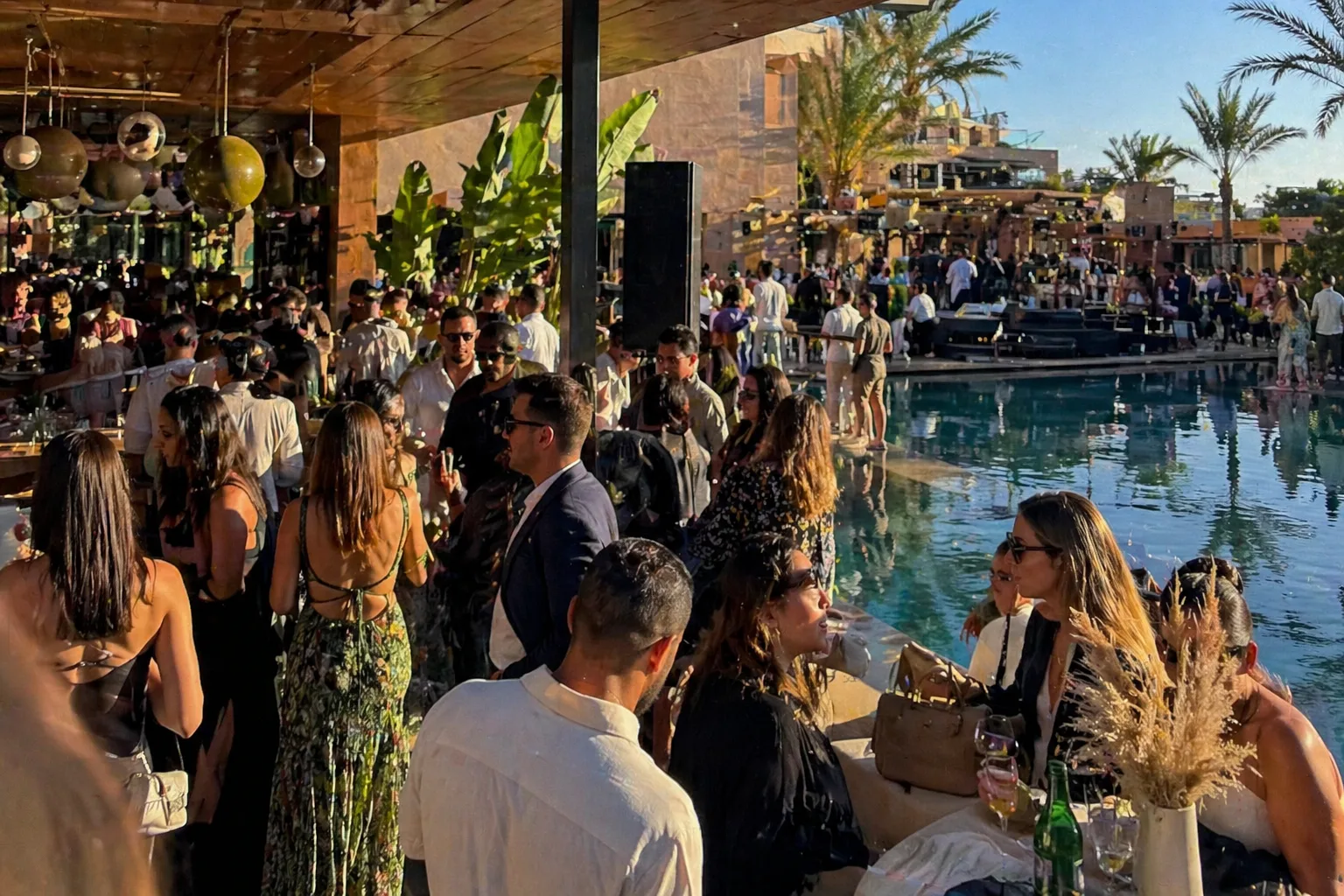
Marrakech continues to strengthen its position as a flagship destination for luxury and lifestyle tourism. The city attracts high-end developments, including boutique hotels, branded residences, and immersive hospitality concepts.
Its appeal lies in its ability to combine heritage with premium experiences, making it a cornerstone of the global hotel expansion in Morocco.
Casablanca: Business and Financial Hub
Casablanca is evolving into the country’s primary business tourism center. Demand is driven by corporate travel, conferences, and international events.
Hotel development in the city reflects this positioning, with a focus on efficiency, connectivity, and service standardization.
Rabat: Institutional and Diplomatic Segment
Rabat is moving toward a more selective market positioning, targeting diplomatic, governmental, and cultural segments. Its hospitality growth is more controlled but strategically aligned with high-value demand.
Together, these urban dynamics illustrate how the global hotel expansion in Morocco is becoming increasingly segmented and strategically coordinated.
Morocco as a Premium Destination for Modern Travelers
Beyond its accelerating investment landscape, Morocco is also strengthening its position as a world-class travel destination where heritage, luxury, and contemporary hospitality converge. The current wave of Global Hotel Expansion in Morocco is not only transforming the investment ecosystem, but also elevating the overall visitor experience to new international standards.
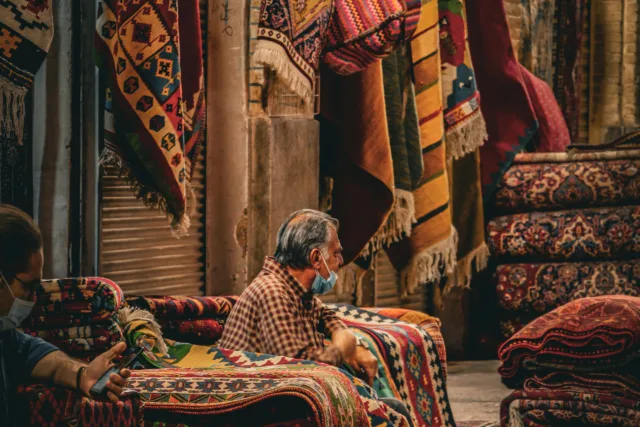
Travelers arriving in Morocco today discover a destination in full evolution. Cities like Marrakech, Casablanca, and Rabat are blending authentic cultural identity with the refined standards of global hospitality brands. Luxury hotels, boutique riads, and high-end resorts are offering increasingly sophisticated experiences, combining traditional Moroccan aesthetics with modern comfort and world-class service.
This transformation is particularly visible in Marrakech, where visitors can move seamlessly from historic medina streets to ultra-luxury resorts managed by leading international hospitality groups. The result is a unique travel experience where authenticity is preserved while service quality reaches global benchmarks.
At the same time, Morocco’s diversity remains one of its strongest assets. From the Atlantic coastline to the Atlas Mountains and the Sahara Desert, the country offers a rare concentration of landscapes within short travel distances. This geographical richness, combined with improved infrastructure and expanding airline connectivity, makes Morocco increasingly attractive for long-stay tourism and premium experiential travel.
In this context, the Global Hotel Expansion in Morocco is not only reshaping investment flows—it is elevating Morocco into one of the most desirable and dynamic tourism destinations in the world.
Learn more about Morocco: Visit Morocco
2030 as a Strategic Accelerator
The upcoming FIFA World Cup 2030 plays a critical role in accelerating the global hotel expansion in Morocco. However, its importance goes far beyond short-term demand spikes.
The event acts as a catalyst for long-term investment decisions by:
- Increasing international visibility
- Reducing perceived market risk
- Triggering infrastructure upgrades
- Encouraging large-scale project financing
Investors are not building for a single event, they are positioning assets for sustained global exposure.
This forward-looking approach reinforces Morocco’s transition into a permanent tourism hub rather than a temporary event-driven market.
Standardization vs. Authenticity: A Structural Tension
One of the most debated aspects of the global hotel expansion in Morocco is the tension between standardization and authenticity.
International brands rely on standardized formats to ensure consistency across markets. While this enhances operational efficiency and customer trust, it can also lead to homogenization.
Morocco’s competitive advantage historically lies in its cultural depth, architectural uniqueness, and artisanal heritage. The risk is that excessive standardization may dilute these differentiating factors.
Maintaining a balance between global standards and local identity is not just a cultural issue—it is a strategic necessity for sustaining long-term competitiveness within the global hotel expansion in Morocco.
Competitive Pressure on Local Operators
The expansion of global brands is intensifying competitive pressure on domestic hospitality players. Local operators face challenges in areas such as:
- Distribution power
- Brand recognition
- Access to international clientele
- Operational efficiency
Without strategic adaptation, smaller players risk marginalization within the evolving ecosystem.
However, this pressure also creates opportunities for differentiation. Local operators who leverage authenticity, personalized experiences, and niche positioning can still capture significant market share within the global hotel expansion in Morocco.
Value Distribution and Economic Sovereignty
A critical issue surrounding the global hotel expansion in Morocco is the distribution of economic value. The prevailing asset-light model raises important questions:
- Who controls revenue streams?
- Where are profits allocated?
- How much value remains within the local economy?
While foreign operators bring expertise and global reach, the long-term objective for Morocco must be to strengthen its domestic hospitality ecosystem.
This includes:
- Supporting Moroccan hotel brands
- Integrating local supply chains
- Enhancing workforce capabilities
- Encouraging knowledge transfer
Achieving this balance is essential for ensuring that the global hotel expansion in Morocco translates into sustainable economic development rather than external value extraction.
Investment Opportunities in a Transforming Market
Despite structural challenges, the global hotel expansion in Morocco continues to generate compelling opportunities for investors, driven by a combination of strong and diversified tourism demand, consistently high occupancy rates in key urban destinations, and a favorable strategic positioning reinforced by upcoming global events. This momentum is further amplified by the growing interest of institutional capital, which increasingly views Morocco as a stable and scalable hospitality market within the emerging world.
Within this evolving landscape, certain segments stand out for their performance and resilience. Luxury hospitality remains a primary driver of value creation, particularly in destinations like Marrakech, where premium experiences command high margins. At the same time, boutique riads continue to attract travelers seeking authenticity and cultural immersion, while branded residences appeal to investors looking for hybrid real estate-hospitality products with international standards. Experiential and eco-tourism projects are also gaining traction, reflecting global shifts toward sustainability and personalized travel.
In this context, investors who adopt hybrid strategies combining asset ownership with professional hotel management are particularly well positioned to capture value. This approach allows them to benefit from both real estate appreciation and operational performance, making it especially aligned with the current dynamics of the global hotel expansion in Morocco.
Emerging Niches and Future Growth Segments
The evolution of demand is creating new investment niches within the global hotel expansion in Morocco:
- Wellness and health-focused tourism
- Sustainable and eco-resorts
- Remote work and digital nomad accommodations
- Cultural immersion experiences
These segments align with global travel trends and offer higher margins due to their differentiated value propositions.
Toward an Integrated Hospitality Ecosystem
The long-term trajectory of the global hotel expansion in Morocco points toward the development of integrated tourism ecosystems.
In this model, hotels are interconnected with:
- Transportation infrastructure
- Cultural and entertainment assets
- Digital platforms
- Urban development strategies
Value creation is no longer limited to room occupancy. It extends to the entire customer journey, from arrival to experience and beyond.
Technology plays a key role in this transformation, enabling data-driven decision-making, dynamic pricing, and personalized guest experiences.
Strategic Outlook: From Growth to Maturity
The global hotel expansion in Morocco is entering a phase where growth must be matched by strategic maturity. The challenge is no longer to attract investment, but to optimize its impact.
Key priorities for the next phase include:
- Strengthening local participation in value chains
- Preserving cultural identity within global frameworks
- Enhancing regulatory alignment with long-term goals
- Encouraging innovation in hospitality models
Morocco has the potential to position itself not only as a leading tourism destination but as a benchmark for emerging hospitality economies.
The global hotel expansion in Morocco represents one of the most significant economic transformations currently underway in North Africa. It is a multidimensional shift that touches investment structures, urban development, cultural identity, and global positioning.
The opportunity is substantial—but so are the strategic decisions that will shape its outcomes.
Morocco stands at a crossroads: it can either remain a high-performing destination within global systems or evolve into a fully integrated hospitality powerhouse capable of capturing and retaining value at every level of the ecosystem.
The direction it chooses will define not only the future of tourism but the broader trajectory of its economic development.
If you’re an investor seeking to navigate the new wave of Global Hotel Expansion in Morocco, Orchid Island Real Estate provides strategic advisory, market intelligence, and tailored investment structuring to help you identify the highest-performing hospitality opportunities.
Contact our team to unlock Morocco’s most valuable hotel investment insights.
Get in Touch With Orchid Island Real Estate
Position yourself where the next real estate cycle is already taking shape.

Leave a Reply